BROADSONIC
Optical Ultrasonic Sensor
the frequency range of human hearing (5 MHz vs. 20 kHz)
Technology
50x Beyond Conventional Ultrasonic Microphones
BROADSONIC uses Fabry-Perot interferometry: laser light travels through a fiber and reflects between two mirrors inside a micro-cavity. When sound pressure deflects the membrane, the cavity length changes, shifting the interference pattern. This optical readout captures the full 0–5 MHz acoustic band with ~100 µPa/√Hz sensitivity — no electrical elements, inherently immune to EMI.
50x = 5 MHz vs. ~100 kHz typical bandwidth of conventional ultrasonic microphones.
Bandwidth Advantage
See the Frequency Spectrum
BROADSONIC covers a frequency range that no other air-coupled sensor can reach.
Technical Specifications
Sensor Performance
| Acoustic Bandwidth | 5 MHz |
| Self-Noise | ~100 μPa/√Hz @ 1 MHz |
| Dynamic Range | >80 dB |
| Active Sensor Area | 100 μm diameter |
| Omnidirectionality | > ±60° |
| Standoff Distance | mm to few cm (non-contact) |
Optical & Physical
| Fiber Type | SMF-28 |
| Fiber Connector | SC/APC |
| Fiber Length | 3 m (standard) |
| Sensor Head | 28 × 8 mm, 3 g |
| Sensor Material | Anodized Aluminum |
| Operating Temp | 15–40 °C |
Control Unit
| Data Interface | USB 2.0 High-Speed |
| Sampling Rate | 10 MS/s, 14-bit ADC |
| Power | 9 VDC, 8.1 W typical |
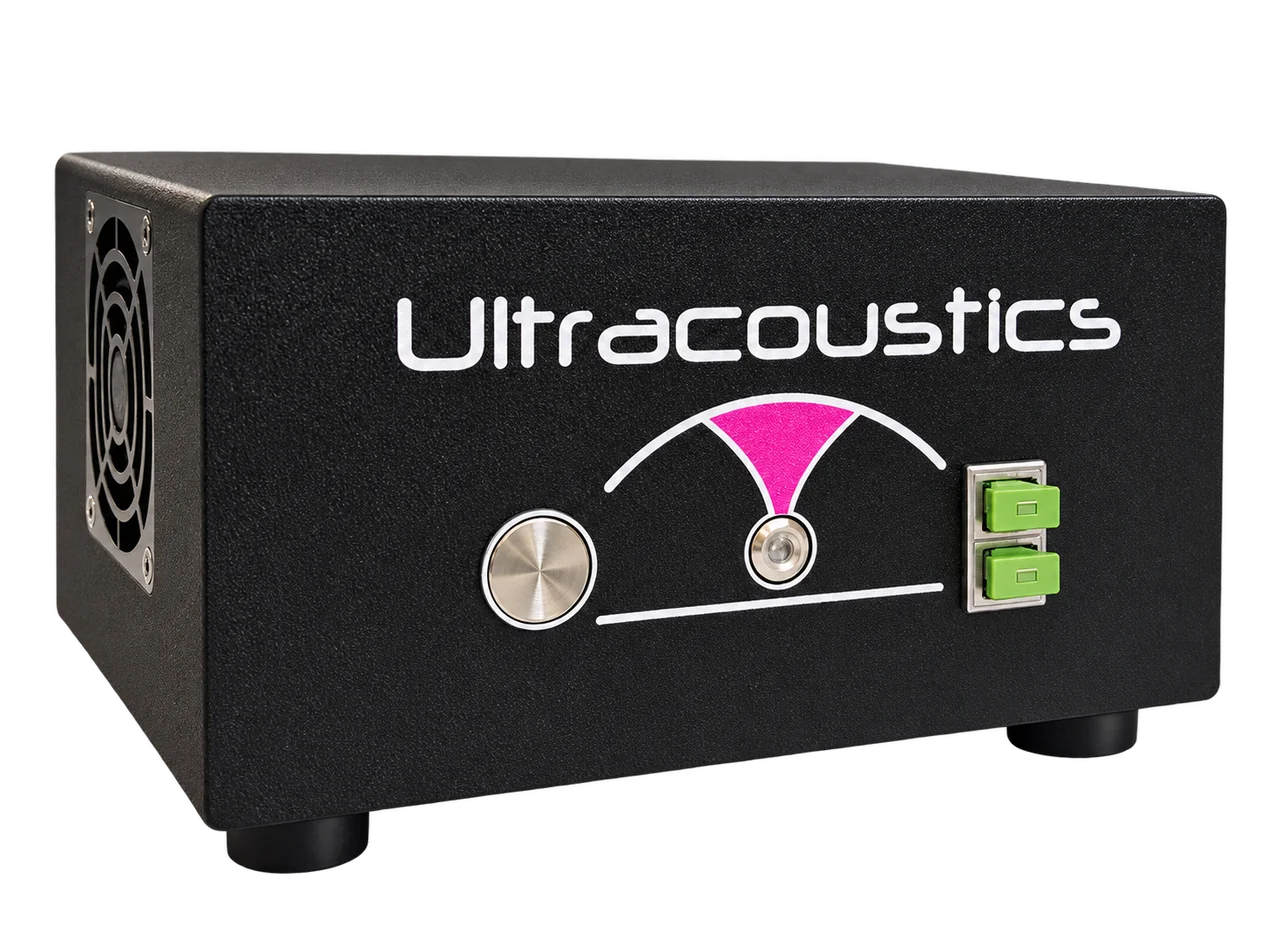
| Unit Dimensions | 17 × 12 × 9 cm |
| Unit Material | CFRP composite |
| Compatibility | Windows 10/11 (64-bit) |
Included Accessories
- 9 VDC power supply
- Probe with 3 m SMF-28 fiber patch cable (SC/APC)
- Drivers and Ultracoustics Data Visualizer software
Included Software
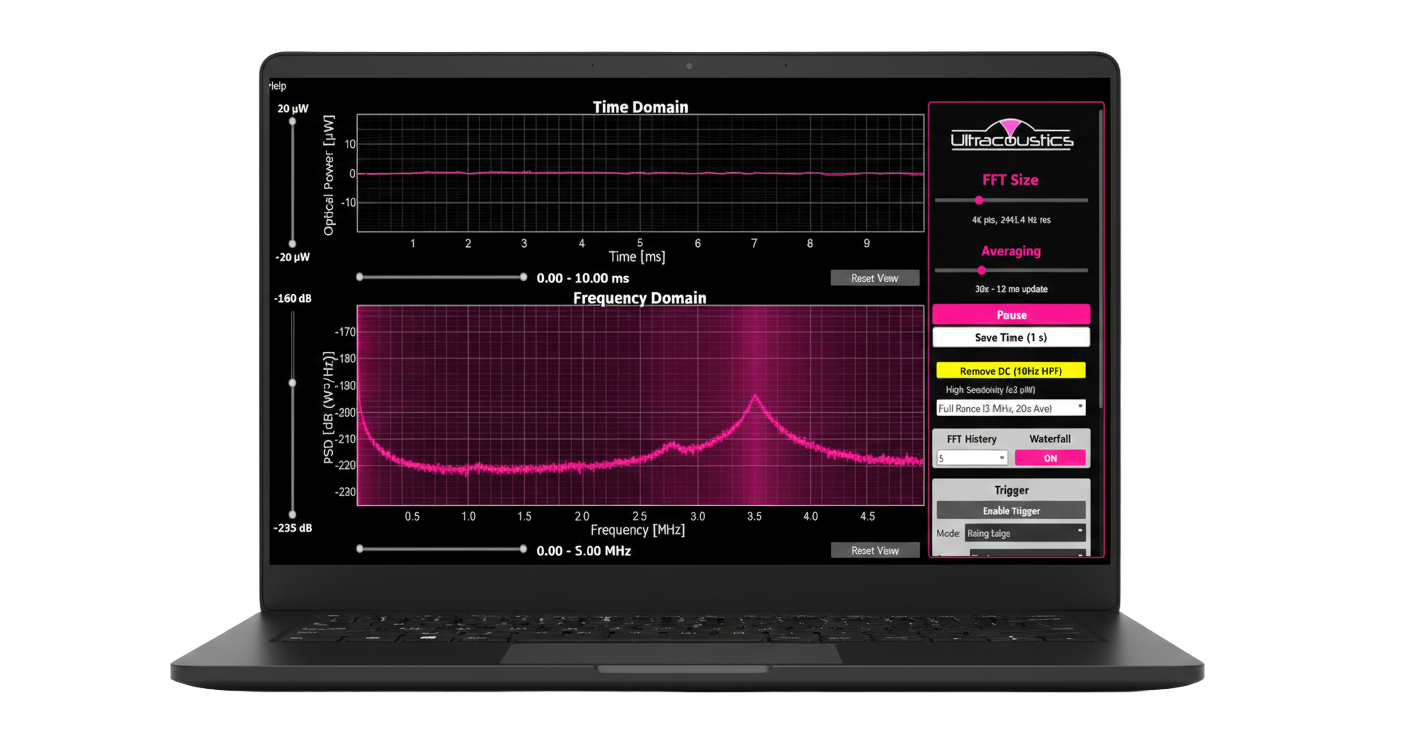
Ultracoustics Data Visualizer
Every BROADSONIC ships with purpose-built acquisition software — designed for ease of use so you can start measuring in minutes and integrate into existing workflows without friction.
Real-Time Streaming
10 MSPS continuous USB acquisition with live time-domain and FFT visualization — no post-processing required.
Broadband FFT Analysis
Preset frequency ranges (Audible, Limited, Full) with configurable averaging for quick setup across use cases.
High Sensitivity Mode
100× gain for detecting weak acoustic signals, with 1 μs resolution in paused mode for detailed inspection.
Trigger & Capture
Automatic threshold-based event detection with configurable trigger levels — capture acoustic events the moment they happen.
Baseline Subtraction
Save and subtract noise background for clean frequency analysis — isolate the signals that matter.
Waterfall Display
Historical FFT tracing to visualize transient frequency components over time with adjustable history depth.
Ready Out of the Box
Extract, launch, and start measuring — no complex installation or configuration. The visualizer connects to your BROADSONIC instantly over USB and integrates seamlessly into your existing test setup.
- OS: Windows 10/11 (64-bit); macOS available on request
- Port: USB 2.0 High-Speed (USB 3.0 recommended)
- Storage: SSD recommended for long recordings
Need deeper integration? An SDK is available on request for teams building custom acquisition pipelines. Contact us to learn more.
⚠ Safety Information
This product emits laser radiation at 1550 nm and 638 nm wavelengths with <1 mW total optical power at the fiber output (Class 1 per IEC 60825-1). While classified as safe under normal operating conditions, avoid direct eye exposure to the fiber end as a precaution. The 638 nm wavelength produces visible red light.
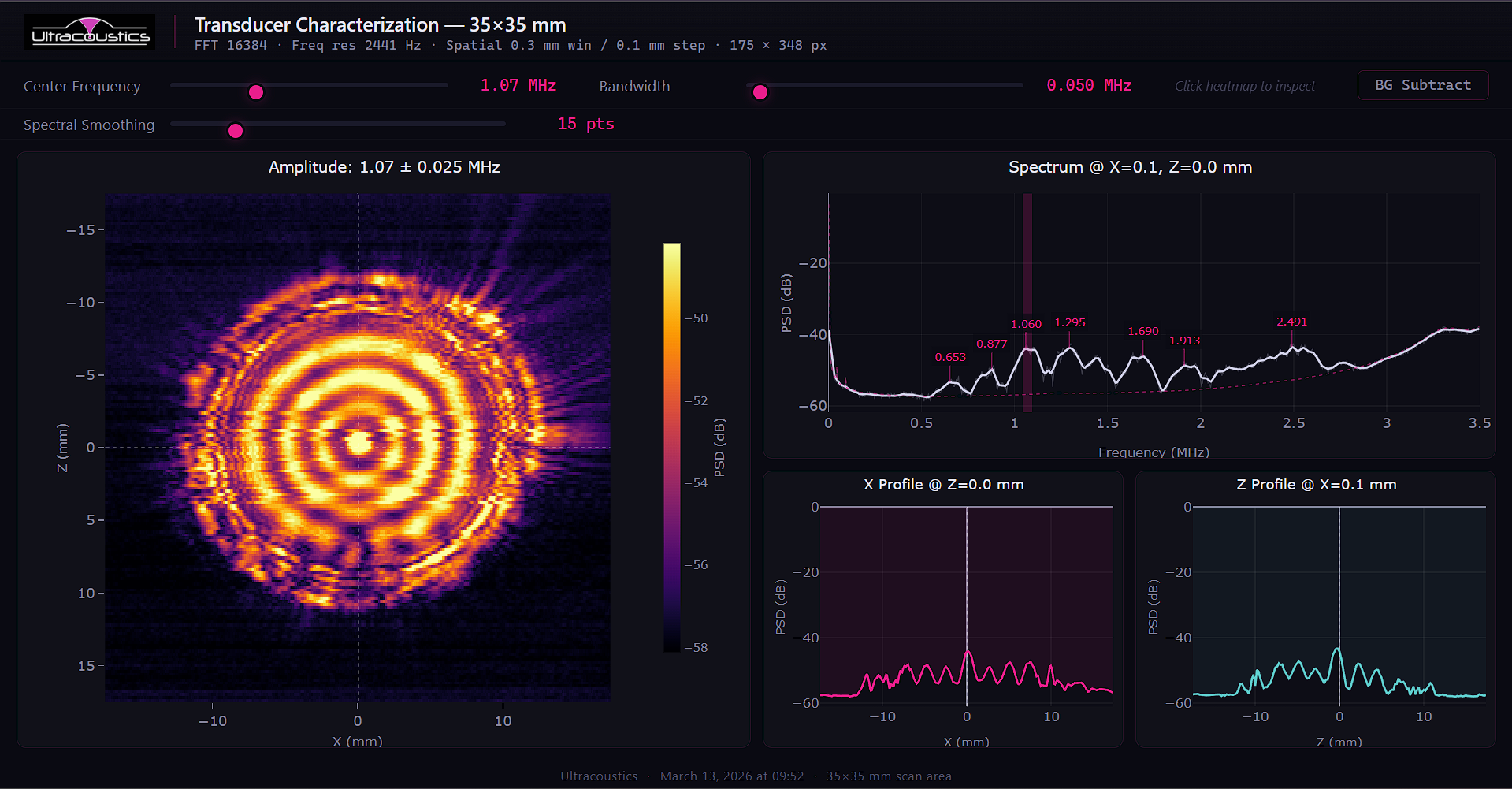
Interactive Demo
Explore Real Data
Spatial vibration scan of a 1.5 MHz transducer at 0.1 mm resolution. Each pixel contains a full frequency spectrum across the 0-5 MHz band.
Ready to Evaluate BROADSONIC?
Download the datasheet for full specifications and the quick start guide for setup and your first measurement, or contact us to discuss your application.